
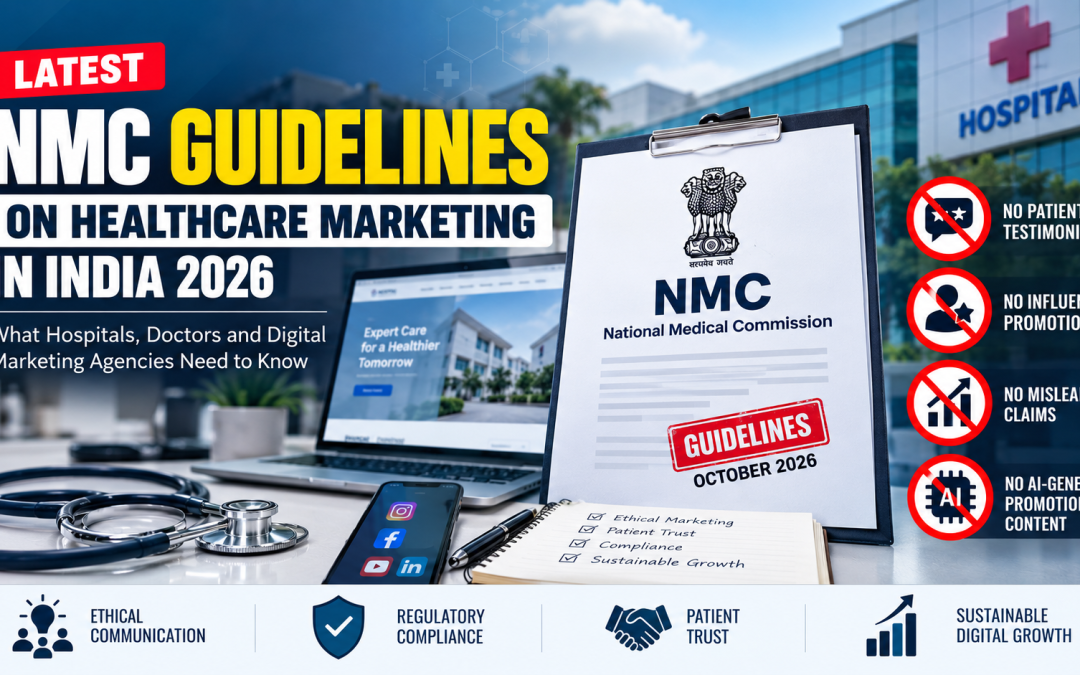
NMC Guidelines on Healthcare Marketing in India 2026: What Hospitals, Doctors and Digital Marketing Agencies Need to Know
The latest NMC guidelines on healthcare marketing in India are changing how hospitals, clinics and registered medical practitioners communicate with patients online. From social media posts and patient testimonials to AI-generated content and digital advertising, healthcare organisations must place greater emphasis on ethical communication, factual information and patient trust.
On 6 October 2026, the National Medical Commission (NMC), through its Ethics and Medical Registration Board, issued the Guidelines on Ethical Advertising and Public Communication by Hospitals/Medical Institutions and Registered Medical Practitioners. The guidelines came into force with immediate effect.
Official source: National Medical Commission — Guidelines on Ethical Advertising and Public Communication.
For hospitals investing in digital marketing, this development raises an important question: How can healthcare providers grow their digital presence while complying with professional ethics and applicable advertising regulations?
At Corecellent Technologies, we believe the answer lies in combining strategic digital growth with responsible, transparent and patient-focused communication.
What Are the Latest NMC Guidelines on Healthcare Marketing?
The NMC guidelines establish a framework for ethical advertising and public communication involving hospitals, medical institutions and registered medical practitioners (RMPs).
Their primary objectives include protecting patients from misleading medical claims, preserving the dignity of the medical profession, discouraging the commercialisation of healthcare and ensuring that medical communication remains factual and ethically responsible.
The guidelines also address digital platforms and modern promotional practices, making them particularly relevant to organisations that use websites, social media, online listings, messaging platforms and other digital channels to communicate with patients.
These guidelines do not mean that hospitals must abandon their digital presence. Instead, healthcare providers need to distinguish between legitimate public information and promotional practices that may breach the applicable rules.
Why Do the New NMC Guidelines Matter for Healthcare Digital Marketing?
Digital marketing has become an important part of how patients discover hospitals, learn about medical services and evaluate healthcare providers.
Hospitals use search engine optimisation (SEO), social media, online advertising, educational videos and websites to communicate their services to the public. However, medical communication requires a higher standard of responsibility because patients may make important health decisions based on the information they encounter.
The latest NMC framework makes it essential for healthcare organisations to review their digital communication practices rather than assuming that content acceptable in other industries is automatically appropriate in healthcare.
The key implications include:
- Greater scrutiny of misleading or exaggerated medical claims.
- Restrictions on promotional testimonials and endorsements.
- Greater attention to the use of AI in healthcare communication.
- The need to review digital advertising and patient-acquisition arrangements.
- Clearer responsibility for content published through agencies and third parties.
- Greater importance of accurate doctor credentials and institutional information.
Hospitals should review the complete official notification before changing individual campaigns, as the precise requirements and exceptions depend on the applicable provisions.
1. Misleading Medical Claims and Exaggerated Advertising
One of the most important principles of ethical healthcare marketing is accuracy.
Medical advertisements should not create unrealistic expectations about treatment outcomes or encourage patients to make decisions based on unsupported promises.
Examples of high-risk claims include:
- “Guaranteed cure for every patient.”
- “100% treatment success guaranteed.”
- “India’s No. 1 hospital” without a valid basis.
- “The best doctor in the city” as an unsupported promotional claim.
- Claims that a treatment is completely risk-free when this cannot be substantiated.
Such statements can mislead patients and undermine trust in healthcare professionals.
What should hospitals do instead?
Focus on verifiable information about medical services, facilities, equipment, qualifications and available treatment options.
For example, rather than publishing an unsupported claim that a hospital provides the best cardiac treatment in the region, its website can explain its cardiac department, available diagnostic facilities, specialist qualifications and services.
SEO tip: Use specific, factual service descriptions on hospital webpages instead of relying on superlatives and unsubstantiated superiority claims.
2. Patient Testimonials, Reviews and Success Stories
Patient testimonials have traditionally been used in marketing to communicate treatment experiences and build credibility. However, the latest NMC guidelines specifically address testimonials, endorsements and reviews used for professional promotion.
Healthcare providers should not assume that obtaining a patient’s permission automatically makes every promotional testimonial permissible.
Particular care is needed when using:
- Patient appreciation videos.
- Recovery stories presented as promotional endorsements.
- Screenshots of patient reviews in social media creatives.
- Before-and-after photographs used to promote medical services.
- Patient interviews designed to solicit new patients.
The exact restrictions and any permitted scientific or educational uses should be assessed against the official guidelines and applicable privacy requirements.
What is a safer alternative?
Develop informative content that explains medical conditions, preventive care, treatment processes and recovery considerations without turning individual patient experiences into promotional claims.
Hospitals can also communicate verified institutional information and publish educational material reviewed by qualified medical professionals.
The objective is to build public confidence through credible information rather than relying on promotional patient endorsements.
3. Influencer Marketing and Celebrity Endorsements
Influencer marketing is common in industries such as fashion, hospitality and consumer products. Healthcare, however, presents additional ethical considerations.
A celebrity or influencer endorsement can create an impression that a particular doctor, hospital or treatment is superior, especially when the endorsement is paid or commercially motivated.
Healthcare organisations should therefore review influencer agreements, sponsored posts and third-party promotional activities against the NMC guidelines.
Do not assume that labelling a post as sponsored or adding a disclosure automatically makes a prohibited medical endorsement acceptable.
What can healthcare organisations focus on?
- Public health awareness initiatives.
- Evidence-based educational discussions.
- Interviews about general health topics.
- Responsible communication by qualified medical professionals.
- Factual information about hospital facilities and services.
The purpose and content of each communication matter. A campaign should not use an influencer to accomplish indirectly what the applicable rules prohibit directly.
4. AI-Generated Content and Healthcare Advertising
Artificial intelligence is increasingly used to generate social media creatives, scripts, images, videos and marketing copy. The latest NMC guidelines make AI-assisted healthcare communication an area that requires particular attention.
AI can support legitimate content workflows, but it must not be used to manufacture credibility or create misleading medical information.
Healthcare marketers should exercise caution with:
- Fabricated patient testimonials.
- Synthetic patient images presented as real patients.
- Invented treatment outcomes or clinical statistics.
- AI-generated doctor endorsements.
- Misleading before-and-after visuals.
- Medical claims generated without clinical verification.
AI-generated or AI-assisted promotional material must be assessed under the specific requirements of the guidelines, including applicable restrictions and disclosure obligations.
How can AI be used more responsibly?
AI can assist with drafting educational outlines, improving readability, organising content calendars and preparing initial versions of general health awareness material.
However, AI-generated medical information should undergo appropriate clinical review before publication. Patient privacy, consent, factual accuracy and applicable advertising rules must also be considered.
The guiding principle is simple: use AI to improve responsible communication, not to manufacture medical credibility.
5. Google Ads, Meta Ads and Paid Healthcare Campaigns
A major concern for hospitals is whether the new NMC guidelines mean that all healthcare advertising is prohibited.
The answer should not be reduced to a blanket yes or no. The permissibility of a campaign depends on the relevant provisions, the advertiser, the content, the promotional purpose and the arrangement through which patients are acquired.
Hospitals and their marketing partners should review campaigns on platforms such as Google, Facebook and Instagram before continuing or launching them.
Areas that deserve particular scrutiny include:
- Ads promising guaranteed treatment outcomes.
- Promotions based on unsupported claims of superiority.
- Discounts, coupons, cashback or free procedures used as patient inducements.
- Paid arrangements designed to manipulate rankings.
- Patient testimonials used to promote medical services.
- Referral commissions or lead-generation payments connected to procuring patients.
A campaign that complies with a platform’s advertising policies is not necessarily compliant with NMC requirements. Both sets of applicable rules must be considered.
What should hospitals do before launching an ad campaign?
- Verify every medical claim with the appropriate clinical authority.
- Review the creative, headline, landing page and call to action.
- Check the commercial arrangement with the agency or advertising platform.
- Confirm that the campaign does not use prohibited inducements or endorsements.
- Document the review and approval process.
Paid advertising decisions should be reviewed against the full official guidelines rather than relying solely on general marketing practices.
6. Healthcare SEO and Google Business Profile: What Needs to Change?
Search engine optimisation remains an important part of helping patients find accurate information about hospitals and medical services.
However, healthcare SEO should not depend on fake reviews, artificial engagement, misleading claims or purchased credibility.
Hospitals should review their websites, search listings and online reputation management practices.
Recommended healthcare SEO practices
Accurate service pages: Publish clear information about departments, facilities, medical services and available consultations.
Verified doctor profiles: Ensure that names, qualifications, registration details and specialisations are accurate.
Useful health information: Publish educational articles reviewed by appropriately qualified professionals.
Transparent hospital information: Maintain correct addresses, contact details, opening hours and other relevant institutional information.
Ethical reputation management: Avoid fabricated reviews, manipulated ratings and prohibited testimonial-based promotion.
Technical SEO: Improve website speed, accessibility, mobile usability, navigation and structured content where appropriate.
SEO does not become unnecessary under ethical advertising guidelines. Instead, healthcare providers need to ensure that visibility-building methods remain truthful and compliant.
7. Doctor Credentials and Transparency in Digital Communication
Accurate professional identification is essential when communicating medical information online.
Hospitals and clinics should review how they present doctors on their websites, social media profiles and electronic communications.
Where required by the NMC guidelines, electronic-media posts should identify the doctor and provide the prescribed qualifications, registration status and State Medical Register or National Medical Register details.
Healthcare organisations should establish a consistent process for verifying these details before publication.
A practical doctor-profile review should include:
- Full professional name.
- Verified qualifications.
- Accurate speciality and role.
- Applicable registration details.
- Correct hospital affiliation.
- Current and authorised professional information.
Hospitals should check the exact disclosure requirements in the official guidelines for each type of electronic communication rather than assuming that every format has identical requirements.
8. Who Is Responsible for Non-Compliant Healthcare Marketing?
An important consideration is the relationship between hospitals, doctors, digital marketing agencies, influencers and advertising platforms.
Using an external agency does not automatically remove a healthcare professional’s responsibility for content they have authorised or knowingly permitted.
Hospitals and medical professionals should therefore establish clear approval procedures with their marketing partners.
What should a healthcare marketing agreement include?
- A clear allocation of content approval responsibilities.
- Clinical verification of medical claims.
- Requirements for factual and ethical communication.
- Prohibitions on fabricated testimonials and misleading claims.
- Appropriate privacy and patient-information safeguards.
- Review procedures for sponsored content and third-party collaborations.
- Clear payment terms that comply with applicable restrictions.
- A process for correcting or removing non-compliant material.
Healthcare agencies should also review their own internal workflows. Compliance should be incorporated into content planning, creative development, campaign approval and reporting.
The final legal position depends on the applicable provisions and circumstances, so hospitals should obtain professional advice when a proposed campaign raises uncertainty.
9. What Should Hospitals Do Immediately? A Practical Compliance Checklist
Hospitals and clinics can use the following checklist to begin reviewing their digital presence.
Website and SEO audit
- Review all service pages and doctor profiles.
- Remove or correct unsupported medical claims.
- Verify professional qualifications and registration details.
- Check patient images, testimonials and promotional case studies.
- Review website forms, privacy notices and patient-data practices.
Social media audit
- Review existing Instagram, Facebook, YouTube and other social media content.
- Identify testimonial-based promotional posts.
- Review influencer agreements and sponsored content.
- Check AI-generated creatives and medical claims.
- Establish a documented content approval process.
Paid advertising audit
- Review Google Ads and Meta advertising campaigns.
- Assess promotional offers and patient-acquisition arrangements.
- Check landing pages and calls to action.
- Verify that payments and commissions do not breach applicable restrictions.
- Confirm compliance with both platform policies and healthcare regulations.
Governance and staff training
- Assign a responsible person to review healthcare communications.
- Involve qualified medical professionals in verifying clinical content.
- Maintain records of approvals and supporting evidence.
- Train marketing staff and external agencies on applicable requirements.
- Seek legal or regulatory guidance where the rules are unclear.
This checklist is a practical starting point, not a substitute for a clause-by-clause legal review.
10. Does Ethical Healthcare Marketing Mean Hospitals Cannot Grow Digitally?
No. The important distinction is between legitimate information-sharing and promotional practices that breach professional or advertising requirements.
Hospitals continue to need accurate websites, accessible service information, educational resources and effective ways to communicate with the public.
The challenge is to design a digital strategy that supports informed patient decisions while respecting professional ethics.
A responsible healthcare digital growth strategy can include:
- A well-structured and technically sound hospital website.
- Search-friendly pages containing accurate service information.
- Educational articles and public health awareness content.
- Informative videos reviewed by qualified professionals.
- Accurate doctor and department directories.
- Transparent communication about facilities and services.
- Website analytics and technical performance monitoring.
- Privacy-conscious enquiry management.
- Compliance reviews for relevant digital campaigns.
Each activity must still be evaluated against the applicable NMC guidelines, advertising laws, privacy requirements and platform policies.
The long-term objective should be sustainable digital visibility built on credibility, not exaggerated claims or artificial reputation signals.
How Corecellent Technologies Supports Responsible Healthcare Digital Growth
At Corecellent Technologies, we understand that healthcare marketing requires a different level of responsibility from conventional commercial marketing.
Hospitals need a digital presence that communicates their services clearly, helps people access relevant information and supports sustainable growth without compromising patient trust.
Our healthcare digital growth approach combines strategic planning, technology, content and performance measurement.
Our services can include:
Healthcare website design and development: Creating accessible, mobile-friendly websites with clear department information, doctor profiles and service pages.
We position ourselves as a strategic healthcare growth partner, helping healthcare organisations connect their digital presence, patient information journey and measurable business objectives.
Our approach is not about promising guaranteed patient numbers or medical outcomes. It is about building a stronger digital foundation through strategy, technology, responsible communication and continuous improvement.
If your hospital is reviewing its digital marketing practices following the latest NMC guidelines, a structured website, content and campaign audit is a sensible starting point.
Frequently Asked Questions About NMC Healthcare Marketing Guidelines 2026
1. What are the latest NMC guidelines on healthcare marketing in India?
The National Medical Commission’s Ethics and Medical Registration Board issued the Guidelines on Ethical Advertising and Public Communication by Hospitals/Medical Institutions and Registered Medical Practitioners on 6 October 2026. The guidelines address ethical healthcare communication and advertising, including digital promotional practices, and came into force with immediate effect.
2. Are hospital advertisements banned in India under the new NMC guidelines?
The guidelines should not be interpreted as a blanket ban on every form of hospital communication or advertising. They establish restrictions and requirements intended to prevent misleading claims and unethical promotion. Each proposed activity must be assessed against the specific provisions and other applicable laws.
3. Can hospitals use social media after the new NMC guidelines?
Hospitals can continue to use digital channels for appropriate public information and educational communication. However, promotional content must be reviewed for compliance with the applicable restrictions on claims, endorsements, testimonials, inducements and other marketing practices.
4. Can doctors post patient testimonials on Instagram?
Doctors should not assume that patient testimonials, recommendations, endorsements or reviews may be requested or shared for professional promotion. The applicable NMC provisions must be reviewed before publishing patient-related content, including reposts and promotional recovery stories.
5. Can hospitals use Google Ads and Meta Ads?
The answer depends on the campaign, the advertiser, the content and the commercial arrangement. Hospitals should assess each campaign under the NMC guidelines, applicable advertising laws and the relevant platform policies before publication.
6. Are AI-generated healthcare marketing creatives allowed?
AI-generated and AI-assisted content requires careful review under the new guidelines. Fabricated testimonials, synthetic patient endorsements and invented clinical outcomes are particularly problematic. Any permitted use must meet the applicable requirements, including relevant restrictions and disclosure obligations.
7. Can hospitals publish doctor profiles and qualifications on their websites?
Accurate professional information is an important part of transparent healthcare communication. Hospitals should ensure that doctor profiles, qualifications, registration details and institutional affiliations are verified and presented in accordance with the applicable disclosure requirements.
8. Can healthcare marketing agencies work with hospitals under the new NMC guidelines?
Agencies can support appropriate website development, content management, educational communication, technical SEO and other compliant digital activities. They should understand the applicable restrictions, establish review procedures and avoid prohibited promotional practices. Hospitals and doctors should also ensure that their agency arrangements comply with the guidelines.
9. What penalties apply to violations of the NMC guidelines?
The consequences depend on the applicable provisions, the nature of the violation and the relevant regulatory authority. Registered medical practitioners may face professional disciplinary action under the applicable framework. Hospitals should also consider other relevant laws and regulatory requirements. The official document should be consulted for the precise provisions.
10. Where can I read the official NMC healthcare advertising guidelines?
Visit the official National Medical Commission website and locate the notice dated 6 October 2026 titled Guidelines on Ethical Advertising and Public Communication by Hospitals/Medical Institutions and Registered Medical Practitioners. Read the complete attached document before making compliance decisions.
Conclusion: The Future of Healthcare Marketing Is Responsible, Transparent and Patient-Focused
The latest NMC guidelines make ethical communication a priority for hospitals, clinics, registered medical practitioners and the organisations supporting their digital presence.
Healthcare providers should review their existing websites, social media accounts, paid campaigns, patient-related content and marketing agreements. At the same time, they should continue investing in accurate service information, useful educational resources, accessible digital experiences and transparent communication.
For hospitals, the goal is not simply to attract attention online. It is to ensure that the information patients encounter is credible, responsible and appropriate.
At Corecellent Technologies, we believe sustainable healthcare growth begins with trust.
If your hospital needs support with healthcare website development, SEO, digital content strategy or a review of its current marketing workflows, contact Corecellent Technologies to discuss a responsible digital growth strategy.
Build visibility. Communicate responsibly. Earn trust.
Disclaimer: This article is intended for general informational and educational purposes. It is not legal advice and does not replace the complete NMC notification or advice from a qualified legal professional. Requirements and exceptions should be verified against the official guidelines and other applicable laws before implementing or modifying a healthcare marketing campaign.

Connect with us by filling out this short form for your exact requirement by following the link:
https://corecellent.com/enquiry/
Or message through email: [email protected]
or WhatsApp: +91-9632668207